
OUR STORY
Zellij Gallery traces its origins to Fez in 1912, where the Farhi family began working within the established tradition of zellij craftsmanship. From the outset, the practice developed through continuity rather than rupture, shaped by time, repetition, and discipline.
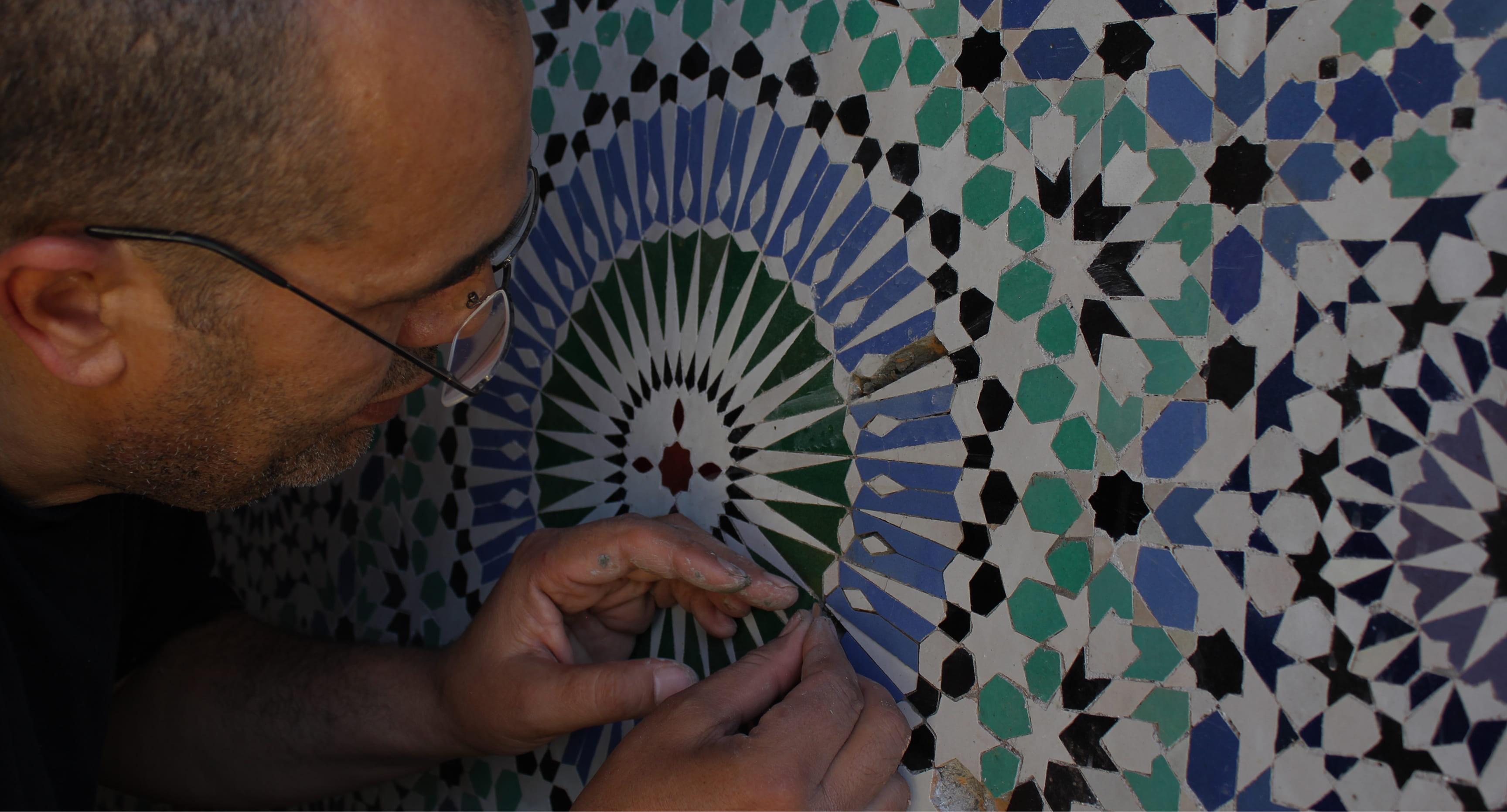
The knowledge of zellij is transmitted through apprenticeship. Maallems are trained not only in technique, but in proportion, geometry, and material behavior—an education refined through years of observation and practice. This lineage, carried from master to craftsman, remains the foundation of the work today.
Zellij is constructed through geometry rather than decoration. Pattern is not applied, but generated, governed by mathematical order and balance. Each composition follows rules developed over centuries, allowing variation without loss of coherence.
Color emerges from natural clay and mineral pigments, shaped by fire and glazing rather than surface treatment. Subtle tonal shifts and irregularities are intrinsic to the process, reflecting both material origin and human intervention.
Over time, the Farhi family expanded the practice beyond Morocco, engaging with architects and designers internationally while preserving the essential methods of production. This dialogue introduced zellij into contemporary architectural contexts without altering its fundamental principles.
All Zellij Gallery tiles continue to be handmade in Fez. The process remains labour-intensive and exacting, supported by specialised artisans working alongside Maallems at each stage. What results is not standardisation, but consistency through craft.
Zellij Gallery operates with a long view. The work is not guided by seasonal trends or stylistic cycles, but by permanence—materials and surfaces intended to age, endure, and remain relevant over time.